Malaysia Payroll Update 2026: Why Smart Employers Are Looking Beyond the 0.75% Contribution
When the Government announced that LINDUNG 24 Jam would become optional for eligible Malaysian employees, one topic immediately dominated social media:
“Do we still need to deduct the 0.75% contribution?”
Over the past week, we’ve received the same question repeatedly from employers, payroll officers, and HR managers.
Interestingly, very few of them were actually asking about the contribution amount.
Instead, they were asking questions like:
- “Do I stop deducting immediately?”
- “What if only some employees opt out?”
- “How should Payroll handle this?”
- “Will this affect foreign workers?”
Those questions reveal something important.
The biggest challenge isn’t the contribution itself.
It’s how employers manage the additional complexity that comes with policy changes.
A Conversation We’re Hearing Every Day
One of our HR consultants recently spoke with a manufacturing company employing over 200 workers.
The business owner wasn’t concerned about saving a few Ringgit each month.
His concern was much more practical.
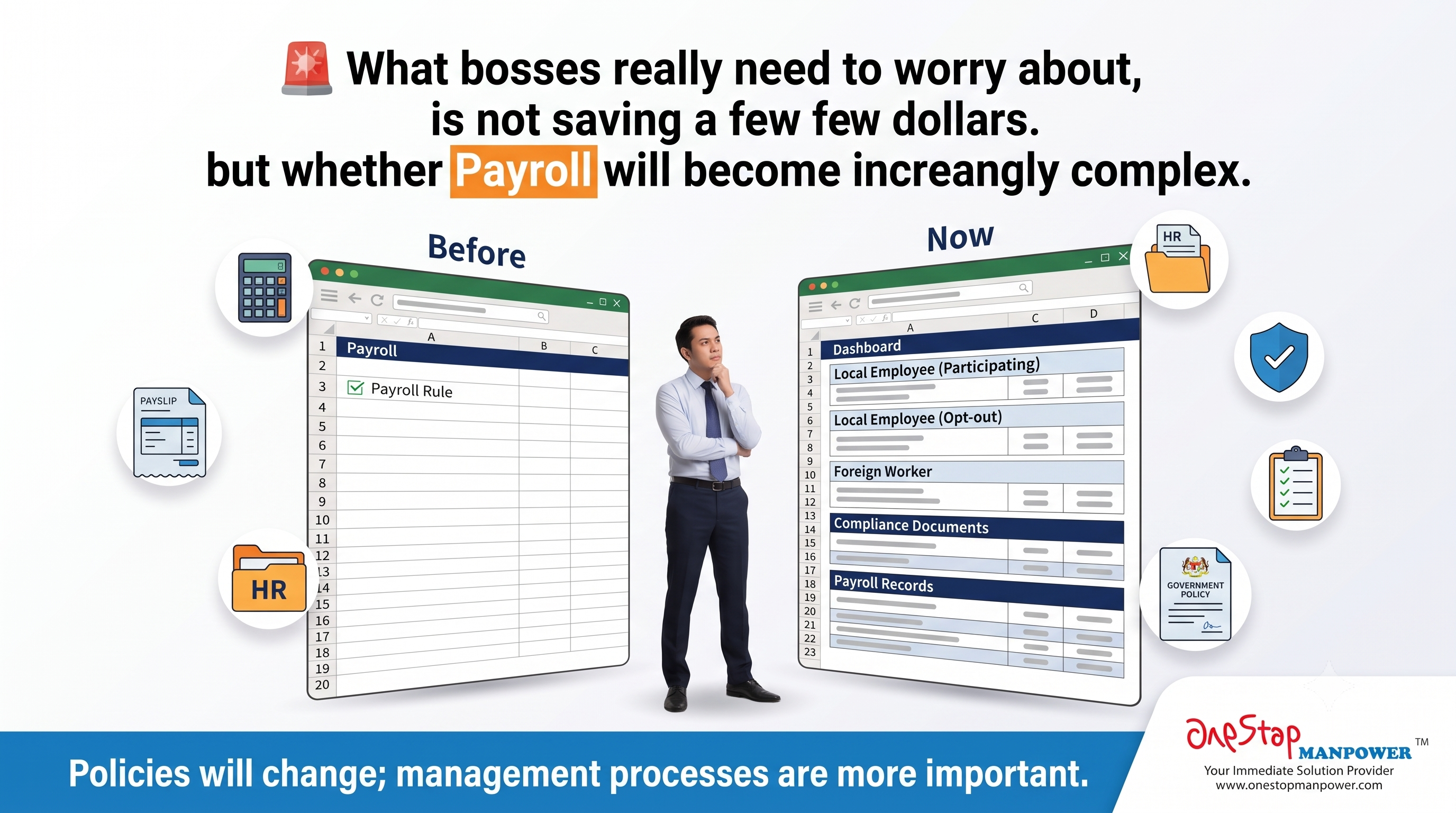
“If half my local employees choose to stay and the other half opt out, how many payroll rules am I managing next month?”
That is exactly the kind of operational question many businesses are now facing.
From an employer’s perspective, policy changes rarely stop at compliance.
They affect payroll workflows, employee communication, record keeping, and HR administration.
Malaysia Payroll Update 2026 Creates More Than Payroll Changes
When employers compare labour costs, they often look at direct expenses.
- Salary.
- Levy.
- SOCSO.
- EPF.
But after years of supporting Malaysian employers, we’ve learned that hidden costs usually come from somewhere else.
For example:
- A payroll officer spends several hours verifying employee participation records.
- HR responds to repeated questions from employees.
- Payroll needs to rerun salary calculations because information changed after processing.
- Managers spend time resolving internal confusion instead of focusing on operations.
- None of these costs appear on a payslip.
- Yet they consume valuable business resources.
Compliance Isn’t Just About Following the Law
Many employers think compliance means submitting contributions on time.
In reality, compliance is also about having a process.
Whenever regulations change, businesses should ask themselves:
- Have we informed affected employees?
- Are Payroll and HR working from the same information?
- Have participation records been documented properly?
- Do we know which rules apply to local employees and which apply to foreign workers?
- Can we explain our records if questions arise later?
Businesses with clear internal processes usually adapt much faster than businesses that rely on last-minute decisions.
Why This Matters Even More for Employers Managing Foreign Workers
For companies employing foreign workers, payroll administration is already more complex than it was a few years ago.
Different statutory requirements.
Different permit statuses.
Different renewal timelines.
Different compliance obligations.
Adding another variable means HR departments need stronger documentation—not just more spreadsheets.
That is why we encourage employers to review their payroll and compliance processes whenever significant policy changes occur.
Three Practical Steps Employers Can Take Today
Instead of asking:
“Can we save a few Ringgit?”
Consider asking:
1. Is our payroll process still accurate?
Review whether your payroll procedures reflect the latest requirements.
2. Are HR and Payroll aligned?
Miscommunication between departments often creates more problems than the regulation itself.
3. Are employee decisions properly documented?
Good documentation reduces future disputes and helps maintain compliance.
Frequently Asked Questions
Does this change apply to foreign workers?
Current requirements differ for foreign workers and Malaysian employees. Employers should always refer to the latest guidance issued by PERKESO and the Ministry of Human Resources, as the applicable rules may differ depending on employee category.
Should employers stop payroll deductions immediately?
Payroll changes should only be made after confirming the latest official requirements and ensuring the appropriate employee documentation or declarations have been completed.
Why are employers still confused?
Because the biggest challenge is rarely the regulation itself.
It’s translating policy into practical payroll and HR procedures across an organisation.
How can employers reduce payroll compliance risks?
Businesses should establish clear HR processes, maintain accurate employee records, keep payroll updated based on current regulations, and seek professional advice whenever new employment policies are introduced.
How One Stop Manpower Supports Employers
At One Stop Manpower (OSM), our role isn’t simply to explain Government announcements.
Our role is to help employers understand:
- What the policy means in practice.
- How it affects payroll operations.
- What documentation should be maintained.
- How to minimise compliance risks.
- How to manage foreign worker administration efficiently.
Whether you’re managing 20 employees or 2,000, our team works closely with employers to simplify HR processes so they can focus on growing their business.
Related Services
- Foreign Worker Application (internal link)
- Payroll Advisory (internal link)
- HR Compliance Services (internal link)
- Work Permit Renewal (internal link)
Conclusion
The Malaysia Payroll Update 2026 reminds employers that compliance is no longer just about paying statutory contributions.
Employment regulations will continue to evolve. Businesses that adapt successfully won’t necessarily be those spending the least.
They’ll be the ones with well-organized HR processes, accurate payroll records, and a clear understanding of compliance obligations.
If your organization is unsure how the latest payroll or SOCSO changes affect your HR operations, One Stop Manpower is here to help. Whatsapp us for faster response!
Our goal is simple:
Turn complex regulations into practical business solutions.
References
- PERKESO (Social Security Organisation)
- Ministry of Human Resources (KESUMA)
- Attorney General’s Chambers of Malaysia – Employees’ Social Security Act 1969 (Act 4)
- Official PERKESO Employer Circulars